International Center for Agricultural Research in the Dry Areas
Biodiversity and Integrated Gene Management - Genetic Resources Section
State of the art genebank facility, and up to global standards procedures and processes
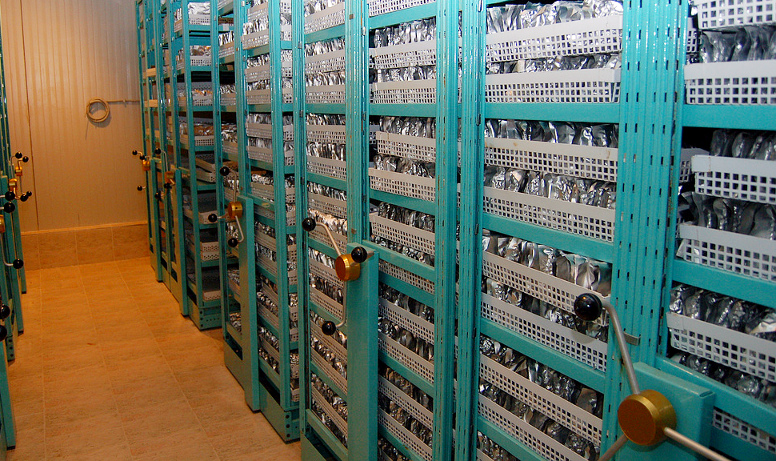
ICARDA�s genebank consists of two large cold rooms with the capacity of 250,000 seed samples (accessions) in each, both cold rooms are of controlled humidity �less than 15%- and equipped with fire protection system.

One of the rooms is used for short and medium term storage with temperature of -4 c for, usually it holds the active collection and any temporary storage of material, each accession is contained in special type of well-sealed jars to prevent humidity. The second room is used for long term conservation of the base collection, accessions are in Aluminume foil vacuumed and sealed bags under -20 c.

The above is the timeline and maps of ICARDA�s collecting missions since 1977, you can click on any year to see the list of countries and map of the collection sites.
Acquiring new material
Acquisition of new material through collecting and approaching donors
Acquisition of new material to complete the collection happens in two ways, one way is to organizing collecting missions to collect from areas that is not visited before �filling geographical gaps�, or to collect species that are not present in the collection �filling species gaps�, the other way is to obtain the material from other genebanks that accepts to donate the material to include it in the global in-trust collection and accepts to make it available under SMTA.

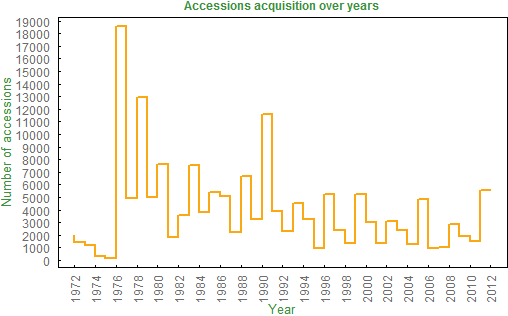
For the past two decades there are 3000-5000 new dryland genetic resources added to the in-trust collection and accessible for researchers and breeders around the world under the international treaty for food and agriculture SMTA.

The graph shows the amount of new accessions added to the genebank every year, since 1972 until today.
Ali Shehadeh and Athanasios Tsivelikas collecting at the buffer zone of a protected area in Greece, August 2013
The making of the collection
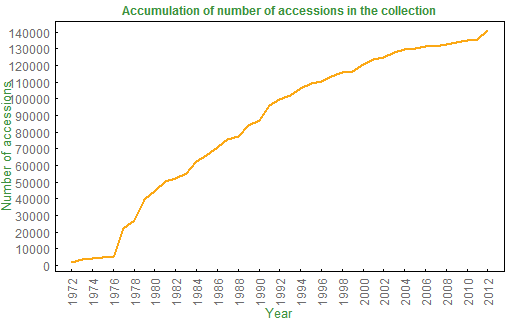
Adding bits and pieces over the past 40 years sums up 140,000 accessions
You can imagine the amount of work done every year to process the received material into the genebank, starting from seed test, planting for seed multiplication, packing and add to base and active collection, and sent it out for seed duplication, doing this for few thousands every year is a labour intensive and costly process.

The road was long and steep, and there is more effort needed in the future before we can say mission accomplished, this will need the continuation of the global community support, and funds, in order to complete and maintain the global collection held in-trust in the CG centres.

The content of the collection
Drylands cereals, food legumes, and feed legumes among other important species are in the collection.
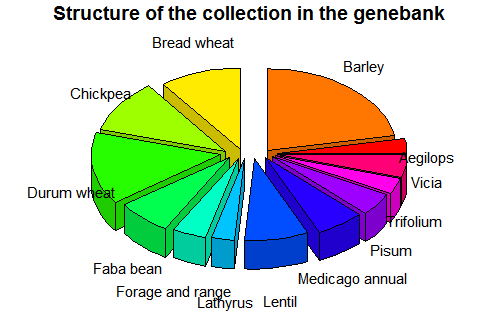
The livelihood of the dryland farmers, is depending on the availability of these plant verities that is well adopted for the drylands environment, ICARDA�s collection is the insurance policy, which will allow the restoration of those eco-systems if modern verities fails to adopt to climate change. The current available accessions in the active collection, which users can request from ICARDA�s genebank, are as follows:
Aegilops 4057,Barley 28465,Bread wheat 14100,Chickpea 14214,Durum wheat 19635,Faba bean 9542,Forage and range 5802,Lathyrus 3996,Lentil 10496,Medicago annual 8398,Pisum 6106,Primitive wheat 912,Trifolium 4536,Vicia 6144,Wild Cicer 270,Wild Hordeum 1989,Wild Lens 587,Wild Triticum 1584

for more information, please visit our online database

The graph shows the amount of new accessions added to the genebank every year, since 1972 until today.